
At AngelMatchup.com, our job is to connect angel investors with startup founders. That means we spend our days reading investor replies, and we have learned that the most useful emails are often not the enthusiastic ones.
Recently we ran an email outreach program for one of our clients, a consumer tech startup in the middle of a fundraise. We sent 545 emails and received seven replies. Two were polite passes, one from 3one4 Capital and one from Kerala Angel Network. Neither was rude, neither was a surprise, and both were more instructive than a dozen “let’s chat” replies.
This post breaks down what those two emails said, what they actually meant, and what founders can do next. Everything here comes from direct experience running outreach, not theory. Your own results will vary by sector, stage and geography, but the patterns are worth knowing.
The Campaign by the Numbers
Out of 545 emails sent, seven recipients replied (1.3%), and two of those replies were soft passes. Here is the full funnel:
| Stage | Count | Share of emails sent |
|---|---|---|
| Emails sent | 545 | 100% |
| Opened | 185 | 33.9% |
| Clicked | 38 | 7.0% |
| Replied | 7 | 1.3% |
| Replied with a soft pass | 2 | 0.4% |
Three things stand out:
- Roughly one in three emails was opened, and about one in five opens led to a click (38 of 185, or 20.5%). The subject line and first lines earned attention; the pitch itself held it.
- Only about 1 in 80 emails produced a reply of any kind. That is the normal shape of cold investor outreach, and it is why a precise list matters more than a bigger one.
- Two of the seven replies (29%) were passes. A pass is still a response: it means the investor opened, read and weighed the opportunity. Those two emails told us more about fit than silence from the other 538 recipients ever could.
One caution on reading these figures: open counts are approximate, because email privacy features and image blocking can both over- and under-report opens. Replies are the most reliable number in the table.
The Two Replies We Received
Here is the first response, from 3one4 Capital:
“Thanks for writing to us. We reviewed this opportunity and decided not to take the discussion forward because we are not looking to invest in this value proposition at the moment. We wish you all the best with the fundraise & the venture. Looking forward to seeing the business grow.”

And the second, from Kerala Angel Network:
“Thank you for reaching out and sharing the information. We have carefully reviewed everything you have provided. Unfortunately, it is too early for us to come in. Hence, we are passing this opportunity for now.”
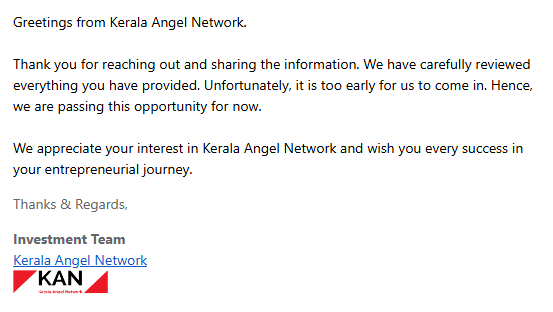
Both ended with warm wishes for the founder. Both used careful, hedged language. And both told us something specific, if you know how to read them.
What Angel Investors Say vs. What They Actually Mean
Investor language is deliberately diplomatic. Nobody wants to burn a bridge, so rejections are wrapped in courtesy. Here is how we read the phrases that show up most often.
| What they say | What it usually means | What you should do |
|---|---|---|
| “We are not looking to invest in this value proposition at the moment.” | A thesis or focus mismatch. The idea may be fine, but it sits outside what they are currently backing. | Re-examine your targeting. Note their portfolio and stated focus. |
| “It is too early for us to come in.” | A mismatch in risk appetite and traction thresholds. They want to see more proof before writing a cheque. | Ask yourself which milestones would change the answer, then go build them. |
| “We reviewed everything you provided.” | Your materials were read. This is a real, if negative, signal. | Treat it as a sign your deck did its job. |
| “We wish you all the best.” | Standard courtesy. It is neither a hidden yes nor an insult. | Accept it at face value and reply graciously. |
| “For now.” | The door is closed today, not forever. | Plan a follow-up, don’t chase. |
The common thread is that a soft “no” is almost never a verdict on you as a person or on the quality of your idea. It is a statement about fit and timing.
Lesson 1: Hyper-Targeted Research Beats Polished Decks
The 3one4 Capital reply is a textbook example of a thesis mismatch. The phrase “this value proposition” tells you the investor has a view on where they want to deploy capital, and your pitch landed outside it.
This is the lesson founders resist most: if your targeting is off, no amount of polishing your deck will save the meeting. You can rewrite your slides ten times and the answer will not change, because the problem was never the slides.
Before you contact any investor, we recommend checking at least these five things:
- Sector and thesis: Do they invest in your category, and have they done so recently?
- Stage: Do they back companies at your level of traction, or do they prefer later or earlier rounds?
- Cheque size: Does your raise fit the range they typically write?
- Geography: Do they invest in your market, or do they have a regional mandate?
- Portfolio overlap: Do they already back a direct competitor, which could rule you out?
A short, relevant email to 25 well-matched investors will almost always outperform a generic blast to 250. Quality beats quantity in outreach, and passes like these are the market telling you exactly where your list was too broad.
Lesson 2: “Too Early” Is Not a Rejection of Your Idea
Kerala Angel Network told us it was “too early” to come in. Founders often hear this as “your idea isn’t good enough.” That is rarely what it means.
“Too early” describes a gap between two things:
- The investor’s risk appetite, meaning how much uncertainty they are willing to underwrite.
- Your traction today, meaning how much of that uncertainty you have already removed.
Angel networks typically answer to members who pool their own money, which often leads to a preference for some evidence of validation. That could be paying customers, a working product, repeat usage, or a clear path to revenue. Without it, the risk can exceed what the group is comfortable with, regardless of how good the idea sounds on paper.
So the useful question is not “why did they reject me?” It is “what would need to be true for this investor to say yes?” Write that list down. It becomes your traction roadmap.
Lesson 3: Don’t Argue. Accept Gracefully.
When a pass lands, there is a strong temptation to reply with a defence: more data, a rebuttal, a justification of your valuation. Don’t.
Defending your valuation or arguing with a pass almost never changes the outcome, and it often burns a bridge you may need later. Angel communities are small and talkative. Investors share notes, co-invest, and remember how founders behaved under pressure.
A graceful reply does three things: it thanks them for their time, it acknowledges their feedback, and it leaves the door open. Always leave on a high note.
Here is a template you can adapt:
Subject: Re: [Startup Name], thank you for the consideration
Hi [Name],
Thank you for taking the time to review our materials and for the clear response. We appreciate the feedback and understand it may not be the right time.
With your permission, we’d like to share a brief update once we reach [specific milestone]. Either way, thank you again, and best wishes to you and the team.
Warm regards, [Your name]
Notice what it does not do. It does not ask for reasons, push back, or pressure them for another call.
Lesson 4: Build a Nurture Funnel. “Not Right Now” Is a Temporary State.
Both replies used time-bound language: “at the moment” and “for now.” Take that literally. A soft pass is a temporary state, not a permanent one.
The founders who raise successfully tend to treat every soft pass as the start of a long-term relationship rather than the end of a transaction. In practice, that means building a simple nurture funnel:
- Log it. Record the investor, the date, and their stated reason in your CRM or spreadsheet.
- Tag the reason. Was it thesis, stage, timing or ticket size? Different tags call for different follow-ups.
- Set a milestone trigger. Decide what progress would justify reaching out again, such as first revenue, a key hire, or a major customer.
- Follow up on evidence, not hope. Every message should carry something new.
Lesson 5: Put Them on Your Update List and Prove Execution
The most reliable way to turn a pass into a yes is simple: show consistent execution over the next two to three quarters.
Investors who said “too early” are quietly asking whether you do what you say you will do. A short, regular update answers that question better than any pitch. Aim for one concise update per quarter, covering:
- Headline metric: users, revenue, or whichever number matters most for your stage
- What shipped: the product or business milestones you hit
- What you learned: an honest note on what didn’t work
- The ask, if any: an introduction, advice, or simply nothing
Keep it short enough to read in two minutes. If your numbers moved in the right direction across consecutive quarters, you have gone from “a pitch we passed on” to “a team we watched execute.” That shift is how a pass becomes a yes.
A Note on Professionalism: Why Responsive Networks Deserve Credit
It is worth saying plainly: both of these investors replied. Many outreach emails never receive a response at all. A clear, courteous answer saves a founder weeks of waiting and guessing.
Kerala Angel Network in particular responded in a structured, professional way, confirming that the materials had been carefully reviewed and giving a clear reason. That kind of clarity is a sign of a mature investment team, and it is something founders should appreciate rather than resent. A quick “no” with a reason is far more useful than a long, silent maybe.
A Quick 90-Day Plan After a Soft Pass
| Timeframe | Action |
|---|---|
| Day 0 to 2 | Send a short, gracious thank-you reply. Log the investor and the reason. |
| Week 2 | Review your target list. Remove investors whose thesis clearly doesn’t match yours. |
| Month 1 | Identify the traction milestone that would answer their objection. |
| Month 3 | Send your first brief update, but only if you have real progress to share. |
| Month 6 to 9 | Share a second update showing sustained execution. Consider re-opening the conversation if the milestone has been met. |
Frequently Asked Questions
Is a polite pass from an angel investor ever a hidden “yes”? No. Take it at face value: it is a no for now. The warm language is courtesy, and the real signal is the reason given (fit or timing).
Should I ask an investor why they passed? A single, polite question can be fine if the relationship is warm, but many investors give limited feedback. Don’t press. Their stated reason in the pass email is usually the honest summary.
How long should I wait before following up with an investor who said “too early”? Typically one to two quarters, and only when you have meaningful progress to report. Updates without new evidence can work against you.
How many investors should I contact in one outreach round? There is no magic number, but a smaller, well-researched list almost always beats a large untargeted one.
Can I pitch the same investor again? Yes, if something material has changed, such as traction, team, product or market position. A re-pitch with new evidence is welcomed far more than a repeat of the same deck.
Key Takeaways
- A soft “no” is usually about fit and timing, not about your worth as a founder.
- “Not looking at this value proposition” points to a thesis mismatch, so fix your targeting rather than your slides.
- “Too early” reflects the gap between an investor’s risk appetite and your current traction.
- Never argue with a pass. Reply graciously and leave on a high note.
- Treat every pass as the start of a relationship, and prove execution over two to three quarters.
Every founder will collect passes. What separates the ones who eventually raise from the ones who stall is how they respond. Stay resilient, stay humble, and let your results do the persuading. A “no” today, handled well, can be the first chapter of a “yes” a year from now.
Mahindar Singh
Founder of Angel Matchup, a platform connecting early-stage startups with verified global angel investors through data-driven matchmaking. With over seven years of experience as an operator, advisor, and matchmaker in the seed-stage ecosystem, Mahindar has built a network of over 1,200 angel investors and helped more than 300 founders navigate fundraising complexities.
He regularly conducts investor-readiness workshops and is passionate about building a fair, transparent startup ecosystem for high-potential ventures worldwide.