
Summary. We ran a small cold email campaign for our client FunBeri, an India-first celebration and gifting startup raising a ~$500K seed round. Of 115 delivered emails, 47 investors opened, 11 clicked through to the pitch deck, and 2 replied, one from Unicorn India Ventures and one from Pavestone VC. Nobody unsubscribed or reported spam. This article shares the numbers, what they do and don’t prove, and how we plan to scale.
Angel Matchup is a company that connects angel investors to startup founders. FunBeri is our client, and we planned and sent this campaign ourselves. Every number below comes from our email platform’s reports for this single campaign; the screenshots are included so you can check them. We have a commercial interest in outreach working, so we’ve flagged the weak points of our own data in the sections below rather than leaving them out.
- 115Delivered97.84% delivery rate
- 40.87%Open rate47 opens
- 9.57%Click-through11 clicks
- 2Investor replies1.74% reply rate
- 0Unsubscribes / spam0% rate
The client: FunBeri
FunBeri is a consumer services and AI startup founded in 2026 and based in Noida, Uttar Pradesh. It is building a “celebration commerce” layer that combines video and messaging, gifting, payments and memory-saving in one flow, with an AI that acts proactively ahead of birthdays and other occasions. The facts in this section come from the company’s own materials, not independent verification.
Founders – Govinda Giri and Swati Dayal
| Stage and ask | Seed, ~$500K (₹4.15 Crore) |
|---|---|
| Pilot (company-reported) | 370K+ participants, $109K GMV at ~24% margin, 40% gifting conversion in live celebrations, 60-90 minute average events |
| Proprietary data (company-reported) | 3.5M birthday records and 24M relationship data points from a previous platform |
| Revenue model | 24% commission on gifts; ₹350/host/year premium hosting; sponsored placements at ₹150-200 per celebration |
| Use of funds | 34% product and AI, 28% team, 17% lifecycle marketing, 12% compliance and payments, 10% reserve |
The objective and the setup
The goal was not to close a round from one email. It was to answer a narrower question: will relevant Indian angel investors engage with FunBeri’s story when approached cold? Success meant investor replies and pitch-deck clicks that could turn into conversations.
Targeting
We selected angel investors in India whose profile matched FunBeri’s company profile, and started with a deliberately small list. Our database also holds LinkedIn profiles, which gave us a second channel for follow-up.
The email
The email’s single call to action was a link to FunBeri’s pitch deck. A reply, with the subject line starting “FunBeri: AI-Powered Celebration & Gifting Pla…”, is visible in the screenshot below. Keeping to one link kept the next step unambiguous and made clicks easy to read as interest.
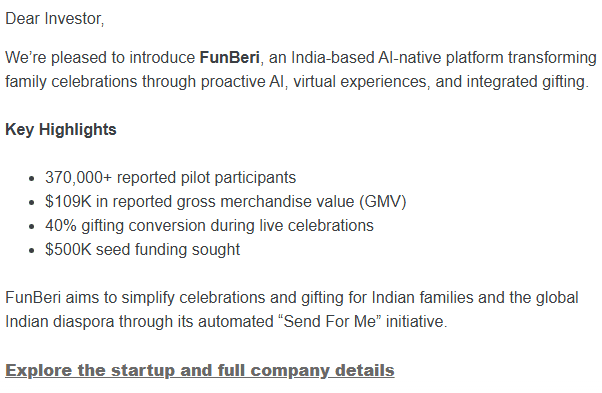
As you can see in the screenshot above, the email itself was kept short and punchy. Busy investors don’t have time for walls of text, so we made it super easy to read and digest in just a few seconds.
Results
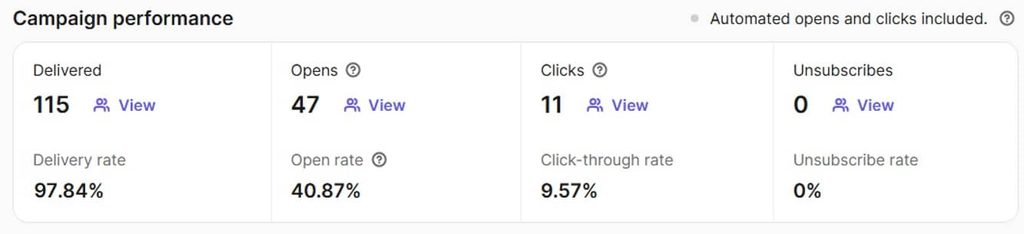
Campaign performance. The platform counts automated opens and clicks.

Opens: 47 unique, 67 total, of which 18 are Apple Mail Privacy Protection opens.

Clicks: 11 unique, 18 total, 23.4% click-to-open. Bot clicks are included.

No unsubscribes and no spam complaints.
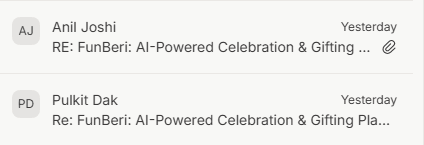
Two replies – Anil Joshi (Unicorn India Ventures, reply with an attachment) and Pulkit Das (Pavestone VC). Both showed initial interest, and we are now in discussions.
The funnel, step by step
| Stage | Count | Share of delivered | Share of previous stage |
|---|---|---|---|
| Delivered | 115 | 100% | n/a |
| Opened (unique) | 47 | 40.87% | 40.87% |
| Clicked (unique) | 11 | 9.57% | 23.4% of openers |
| Replied | 2 | 1.74% | n/a |
| Unsubscribed or complained | 0 | 0% | n/a |
What most campaign write-ups leave out
Headline engagement numbers look impressive, but several of them are softer than they appear. Here is how we read ours.
1. Open rate is a ceiling, not a measurement
Our report includes 18 Apple Mail Privacy Protection opens, which Apple generates automatically whether or not a person reads the email. If every one of those belonged to a distinct recipient and none was a real read, the floor would be 29 of 115, or about 25.2%. The true human open rate sits between roughly 25% and 41%. We would not claim more precision than that.
2. Clicks may include bots
Security scanners at firms and email providers often click links automatically. Our 11 unique clicks include bot clicks, and the 18 total clicks (about 1.6 per clicker) could mean repeat deck visits or scanner activity. We can’t separate the two, which is why we treat clicks as a follow-up list rather than as proof of interest.
3. Replies are the metric that counts
Two replies from 115 delivered emails is a 1.74% reply rate. It is the only outcome in this campaign that clearly required a human decision. Because the sample is tiny, the statistical range is wide: a 95% Wilson interval for 2 of 115 runs from about 0.5% to 6.1%.
4. Zero spam complaints is encouraging but not conclusive
With 115 recipients, zero events only tells us the true rate is likely below roughly 2.6% (the “rule of three”: 3 divided by 115). Relevance of targeting is a plausible reason for the clean result, but this sample can’t confirm it.
5. We skipped generic benchmarks on purpose
Many reports compare their results with broad “B2B cold email” averages. We don’t, because reliable published benchmarks for cold outreach to angel investors are scarce and definitions of “open” and “click” differ between platforms. The meaningful comparison will be our own next send.
The scaling math
We plan to repeat the campaign to 1,000+ investors, aiming for 15-20 responses. At the observed 1.74% reply rate, 1,000 delivered emails would produce about 17 replies, so the target is consistent with the data. The statistical range, though, implies anywhere from roughly 5 to 61. We treat 15-20 as a hypothesis to test, not a forecast. Larger lists also tend to include looser matches, so we expect some regression and will track reply rate per segment.
What we’re doing next
- Reply handling: continue conversations with Unicorn India Ventures and Pavestone VC. Replies show interest, not a commitment, and no funding has closed from this campaign.
- Clickers: follow up on LinkedIn with the 11 who clicked, referencing the deck.
- Openers who didn’t click: test a short follow-up with a fresh traction update.
- Scale: repeat to 1,000+ investors and compare reply rate with this baseline, testing one variable (such as subject line) at a time.
Limitations
This is one campaign, one startup, one small list, with no control group. Open and click counts include automated activity. Reply quality is still unknown, and the traction figures in the client section are company-reported. Treat our results as a worked example, not a guarantee.
Takeaways for founders raising a seed round
- Judge cold email by replies and conversations, not opens.
- One clear link to your deck keeps the call to action easy to measure.
- Start with a small, well-matched list, check the numbers, then scale.
- Prepare a second channel (such as LinkedIn) for people who engage but don’t reply.
Frequently asked questions
In this campaign it produced investor replies from a small list, but one sample is not proof. Warm introductions often carry more weight, so cold email works best as an added channel.
We saw 1.74% (2 of 115). With a sample this small, the plausible range is about 0.5% to 6%.
Apple Mail Privacy Protection and security scanners generate automated opens and clicks, which inflate the figures.
Mahindar Singh
Founder of Angel Matchup, a platform connecting early-stage startups with verified global angel investors through data-driven matchmaking. With over seven years of experience as an operator, advisor, and matchmaker in the seed-stage ecosystem, Mahindar has built a network of over 1,200 angel investors and helped more than 300 founders navigate fundraising complexities.
He regularly conducts investor-readiness workshops and is passionate about building a fair, transparent startup ecosystem for high-potential ventures worldwide.